Tag Ford

Is THIS a Gapp and Roush Maverick?

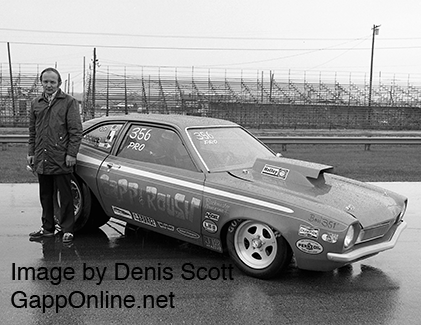
Saw the first picture below on the Nostalgia Pro Stock group on Facebook. The original image comes from Reed Koeppe, Drag Racing historian.

I find the topic to be interesting as I don’t know the location of many of my father’s vehicles.

The 69 Mustang body is in the hands of Daryl Huffman. The Cougar has vanished. The Comet Cyclone was scrapped.

Brett Hajek has a vehicle but some things on it just look wrong (bumpers, windows). My Dad thinks it’s a match racing car they built. The 4 door Maverick is gone and Roush had a clone put together but it’s not finished. The 1972 Pinto was sold to Glidden. I’ve seen a Glidden Pinto sold recently but don’t know if that car is a rebuilt version of the ’72 original or not.

The Super Stock Mustang is in Roush’s hands.

That leaves the 1973, 76 and 77 Pinto’s and the Maverick’s.

I know that the ‘Red’ Maverick was sold to Jim Halloran but lost it from there. Never knew what happened to the ‘Blue’ Maverick.

I would love to get my hands on the Red Maverick.

Anyway…

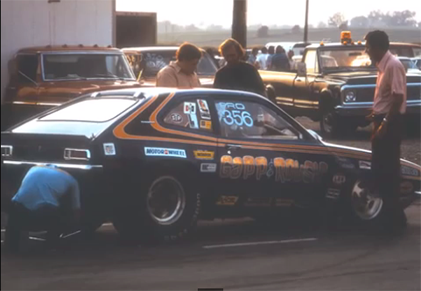
The question is: Could this…
SafariScreenSnapz014

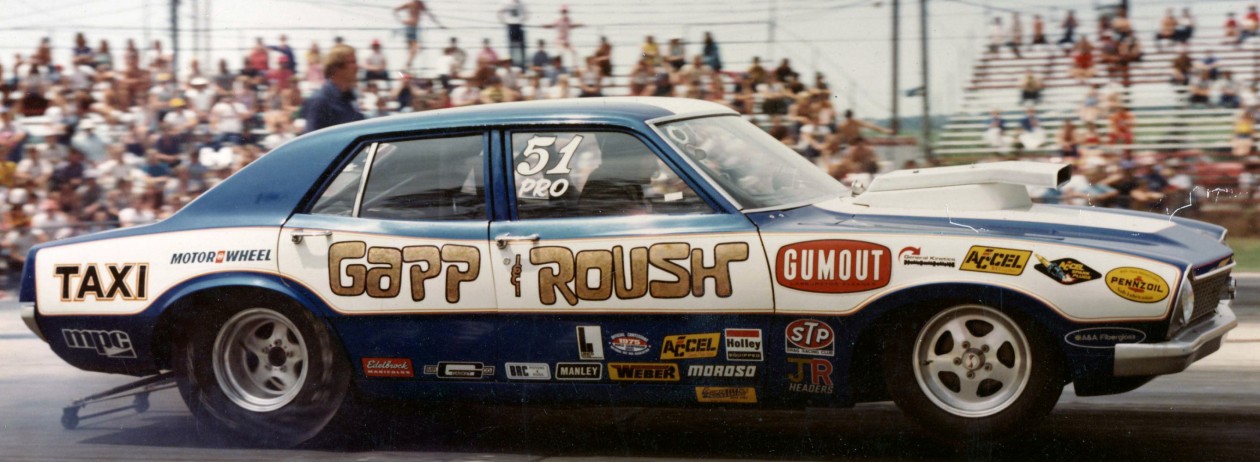
…be this?
Maverick.png

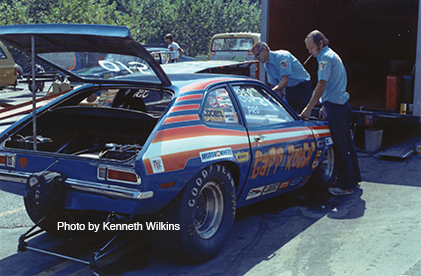
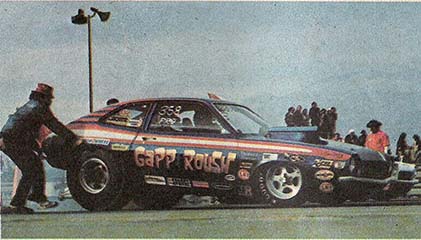
…or this?
GappRoush1972Dragway42psmatchracephotobyToddWingerter 2.jpg

It would be cool if it was…

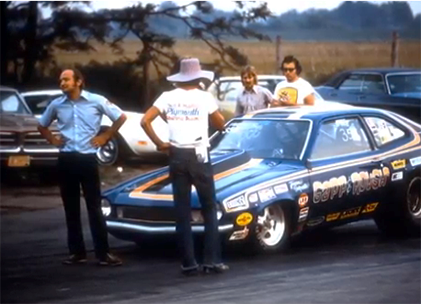
1976 Gapp and Roush Pinto

Bought a few negatives here and there and came across this shot.

The color in the image is great and the shot shows the details of the car.

1976 Ford Pinto Gapp and Roush

Time for a shot of the ’73

Been some time since I’ve put up a shot of the 1973 Pinto.

That’s WG center left.

Img447

NHRA photo of the week

The NHRA posted this as the photo of the week!

Pretty cool of them to do that.

Too bad they don’t have a picture from 1975 when WG won the event.

This is NHRA’s recap of the 1975 event here.

I can help with a picture.

FYI. If I were to nitpick the picture that NHRA selected is from 1976. See here for a list of cars and paint schemes by year.

Wayne Gapp Poster

One of my favorite racing related items…period. I have one of these that is badly beat up. One of my Mom’s friend had this one and gave it me.

PhotoshopScreenSnapz001

Another shot of the Taxi…

This one comes from Daryl Huffman who did the restoration of the ‘Gate Job’ Comet.

Taxi Huffman

Ford’s Boss 429 – An analysis

I decided I would get a few articles from the time period that talk about the Boss 429 and the 351 Cleveland. They are interesting reads especially when compared with what is said today. Check out this one from the January 1970 edition of “Car Craft”

CarCraftJan1970 Boss429

Boss 429 – An analysis by Terry Cook

Page 36 | CAR CRAFT | JANUARY 1970

Ford’s Boss 429, Blue Crescent, Shotgun Motor, Twisted Hemi, call it what you like. Many people are calling it a stone. Going in we decided to discard all the poor reports we had received on the Boss 429 engine and try to approach it from a fair and impartial standpoint, to give the engine, and Ford, an even chance.

In the following pages we have evaluated the Boss 429 from four different standpoints: as a totally stock “out of the box” showroom new product; as a slightly modified street and strip dual purpose performer; in several all-out fully drag strip-prepared cars; and, finally, on Crane Engineering’s dynamometer. In addition, for your edification, we are including the big inch aluminum block offshoot of the Boss 429, the 494. After conducting the four-pronged test we have concluded, as have others, that the Boss 429 engine fails in its present form when applied to the street performance situation. While the engine may be dominating the NASCAR Grand National Stock Car circuit down south, it seems to lack when tested on the drag strip. Although an industrious few – like Dave Lyall, Wayne Gapp, and the guys at Foulger Ford – have made semi-respectable showings with the engine, the Boss 429, to date, is a loser in the drag car bailiwick. The purpose of the text that follows is to tell you the reasons the Boss 429 has fared and failed, and to suggest how the situation, which is a lot bigger than the Boss 429, might be alleviated.

The answer, lies in Ford Motor Company’s approach to the whole performance car market.

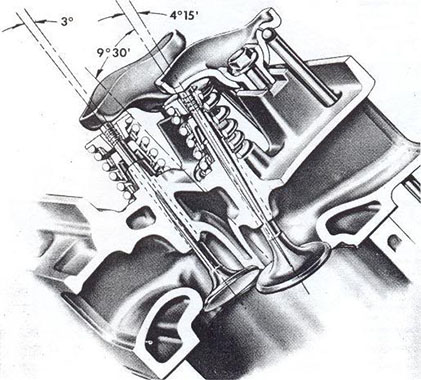
Originally, the Boss 429 was developed with NASCAR (Grand National Stock Car) racing as the primary application, but as with the SOHC Ford engine, a secondary outlet for the equipment was found in drag racing. In order to legalize the Boss 429 engine for NASCAR use, 500 of the engines had to be built and offered in an available car, thus the Boss 429 Mustang was born. Because the engine was designed strictly for the NASCAR circuit, it is tailored to operate at high rpm’s. This fact can be quickly verified by checking the size of the intake and exhaust ports. They are enormous, and are generally inefficient’ at low rpm ranges.

As is common with many of Detroit’s “crash” programs, the 429 design engineers had a very limited time (in this instance only three months) to transform their NASCAR Stocker engine to a street performance car package. Although the engine was not originally designed or intended for street use, the engineers waded into the job. During the transformation from race engine to street motor, certain compromises had to be made for production and warranty reasons. For example, a single four-barrel 735 cfm carb was chosen, which is street-able, but not exactly a performance induction system for an engine of this size. Also, a massive weight valve train

was used in the street version of the Boss, which, together with the 1969 hydraulic camshaft, resulted in a performance peak of 5400 rpm. Anything close to the 5500 rpm from the engine was inviting valve float. Remember that the engine was primarily designed for high rpm operation, but because of the cost of the lightweight valves was prohibitive for production use, heavy valves were used and thus the street engine was not capable of the needed high rpm’s and another inherent problem was created. Although Ford put a 370 horsepower figure on the street version of the Boss 429 engine, the NHRA re-factored it to SS/D, which didn’t help Ford’s chances at the drags.

But the key to all of Ford’s problems with the performance cars and the thing that really put the blocks to the Boss 429 Mustang was that corporation’s Product Acceptability Standard (P.A.S.). The edict handed down from the higher-ups at Ford says that any car made and sold by the company must start when the engine is hot, start in cold weather, idle, run in traffic in fourth gear, and run smoothly at 20, 60 and 80 mph, just like a Lincoln Continental. In addition, the P.A.S. demands that the engine compartment, passenger compartment, and overall noise levels must not exceed a certain maximum. Then there’s always the performance car’s friend, the emission regulations, which are getting tighter every year. Put it all together and you can see that the Ford engineers had to do the impossible: build a production car that starts and behaves as docile as a Thunderbird, yet runs like Wayne Gapp’s injected gas Funny car. They managed to meet the P.A.S., thus the Boss 429 doesn’t make it as a muscular performer.

In comparison, the 429′s drag strip competitors, especially Plymouth and Dodge, don’t have the rigid acceptability standards that serve to strangle performance. A Road Runner or Hemi Barracuda will idle a bit rougher and stumble a bit in fourth gear when you try to lug it around in traffic at 20 mph. However, step on the throttle of a 383 Dodge or Plymouth and you’ll blow any stock Boss 429 Mustang directly into the weeds. Even the 340 Darts and Dusters, let alone Chevy’s Z-28, may give the Boss a tough row to hoe. While the Chrysler and General Motors products do have certain standards they must live up to, they don’t choke their performance cars to the point where acceleration is drastically hampered. Until Ford Motor Compony loosens their Product Acceptability Standard for their performance cars, they will continue to take a back seat to General Motors and Chrysler Corporation in performance. The emission laws are one insurmountable obstacle, but there is no government legislation that says a Boss 429 (or Cobra Jet) must ride like a Lincoln. We want to see Ford improve their position and penetration in the Muscle Car market, but the higher-ups at Ford think a competitive car is one that can spin street tires on wet pavement. Until they start making and selling cars that can hold their own against the competition on the nation’s drag strips, Ford will miss their due shore of the performance pie.

Drag Strip Applications

Ford’s factory-backed drag racers haven’t tried the Boss 429 because they were (1) unable to get parts from Ford (Montgomery & Robinson), or because (2) they wanted to see someone else make it work first. Kalitta has had limited success at the toll of much parts breakage, but two Ford employees, dyno operator Dave Lyall and design engineer Waye Gapp, have made the best drag strip showings with the Boss 429 to date. Gapp has a gas injected Funny which has run a strong 9.02-152. Lyall has two cars. The first is an NHRA SS/D Mustang which has run 11.24-124, but sincy you need 10.8′s on the 11.00 class e.t. record to be competitive, Dave feels the engine should be refactored to a lower class. Lyall’s other car is a gutted 3000-pound heads-up Super Stocker with glass fenders, doors, etc. The heads-up engine has a stock strock NASCAR crank, M/T aluminum rods and 13.4:1 pistons, polished ports, a Cran or Holman & Moody flat tappete cam, lightened rockers, and home-built dual four-barrel induction system. The car has turned 10.21-134.92 which is great for a Boss 429, but hardly enough on a circuit that requires 9.8′s to win. Gapp and Lyall are both doing a commendable job of exploring the engine’s potential, but unless Ford makes the parts available and the “names” try Boss 429′s in place of their ‘cammers’ the drag strip prognosis for the Boss 429 engine is, at best, bleak

DragStripApplication1
Above – Wayne Gapp’s injected gas funny has run low nines.

Below – Dave Lyall and his respectable low-ten Boss 429.
DragStripApplication2

Project 1320 – Drag Racing Action

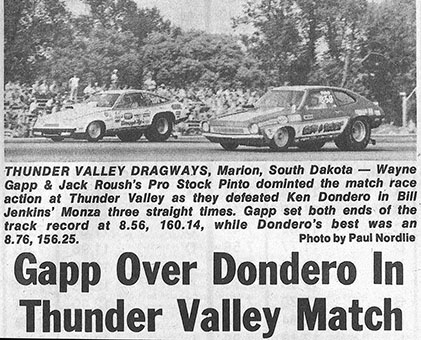
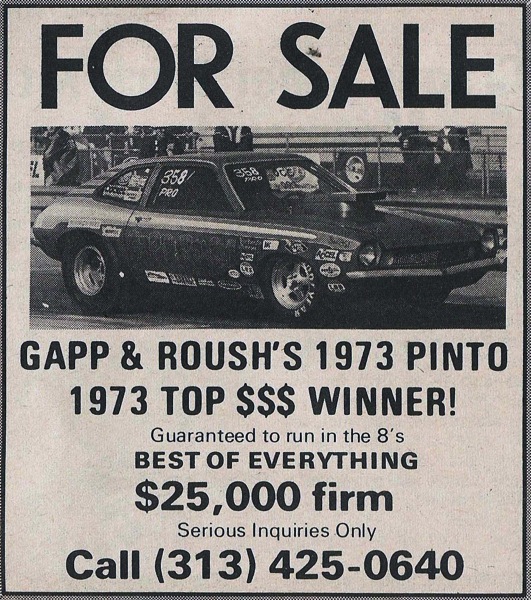
So I was perusing the Internet the other day and ran across the picture below as part of PDF file that was created for Project 1320. See that site here. They are doing some cool stuff.

They may wish to look a bit closer at the images. Here is the caption:

“Before the famed four door “Tijuana Taxi” Maverick came the Gapp & Roush Pro Stock Ford Pinto. Jack pulls the wheels out of the lights at the 1973 Popular Hot Rodding Nationals.”

Ahh..no.

The original image is large enough that:

  1. You can clearly see that isn’t Roush
  2. The driver number is 358. WG’s number was 358.

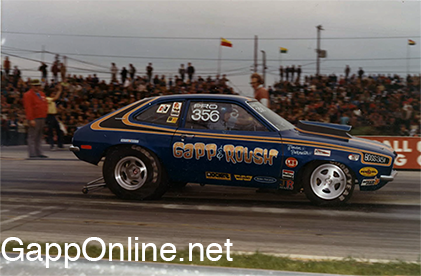
Here is a bit of information about the NHRA Driver numbers that Gapp and Roush used. In general from 1971 to 1975 they used ’356′ on the car when not using ’1′ or ’51′. If they were running two events before 1975 they each used their own number ’356′ for Roush and ’358′ for Gapp.

After 1975 I haven’t seen a car that carried ’356′…only ’358′ or Dondero’s which I think was ’1006′.

That’s because the two were operating as separate businesses and there was no need for Roush’s number.

Edit: I think this might be the Popular Hot Rodding meet held in Martin, MI

GandRProject1320

Bill Roell picture of the Red Gapp and Roush Maverick

ByBillRoellWeb

I really like this car. It’s the last Boss 429 ride. The red paint job with the striping looks great. It’s got a clean look to it and though you can’t see it in this picture it has an amazing paint job on the trunk lid. To see that go here and scroll down to the Red Maverick.

A couple of notes about this picture:

  1. The caption states that Gapp & Roush were sponsored by Ford at this time. That is not the case and as a matter of fact they were NEVER sponsored by Ford. Ford got out racing and that…was that.
  2. If the first point is true, why the big ‘FORD’ log on the side? I asked about that. They were trying to get Ford to sponsor them. Never happened.

Wayne Gapp and the Tijuana Taxi

Here’s a promotional flyer put together by Edelbrock.

Taxi EdelbrockPromotional

Content Protected Using Blog Protector By: PcDrome.